How Do You Safely Introduce a Cat and a Dog?
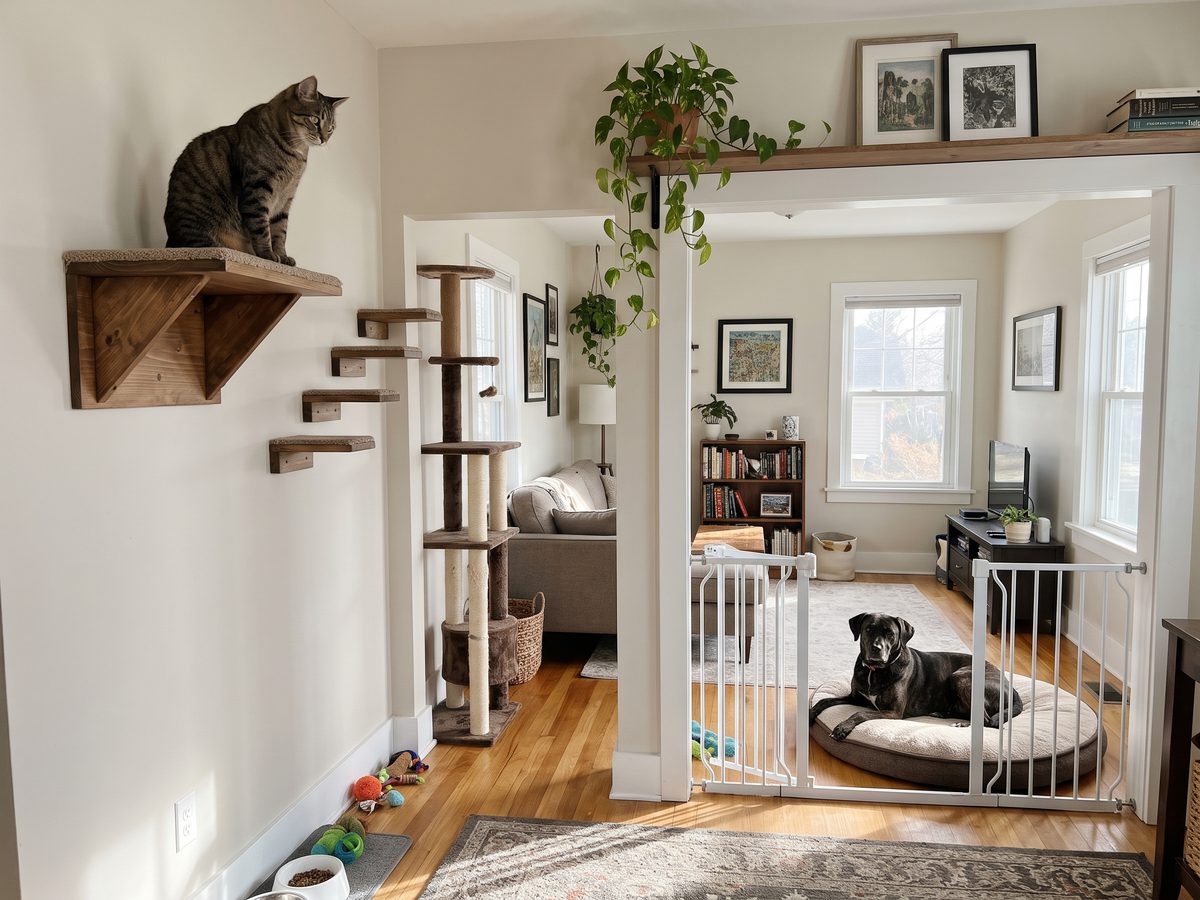
Physical management tools do more work in this process than any single training trick ever could.
| Tool | Role it plays | When it matters most |
|---|---|---|
| Baby gate or screen door | Lets both animals see and scent each other without direct contact | Every early-stage session |
| Leash indoors | Keeps a handler in control of the dog's proximity and movement | The first several supervised meetings |
| Vertical, dog-free space | Gives the cat a reliable escape route at all times | Permanently, not just during introductions |
| The never-chase rule | Stops a chase instinct from ever getting rehearsed and reinforced | Every single interaction, forever |
The Never-Chase Rule
A single successful chase, even a short, "playful" one that ends with the cat safely up on a shelf, teaches a dog that chasing a fleeing cat is rewarding, and that lesson can undo weeks of careful introduction within a few short moments.
The rule is absolute: a dog on leash during every early interaction, a handler ready to redirect attention the instant a stare fixates or a body stiffens toward the cat, and zero tolerance for even a brief, seemingly harmless dash. Nothing about this process forgives a single lapse, since one exception can undo weeks of careful groundwork in an instant.
Gates, Leashes, and Escape Routes Come First
Before any direct interaction happens, the household needs the physical tools in place: a baby gate or screen door that lets both animals see and smell each other from a safe distance, a leash for the dog during every early session so a handler can intervene instantly, and permanent vertical territory (shelves, a tall cat tree, a baby-gated room) that the cat can reach and the dog cannot.
These tools don't just manage risk during the introduction phase; the cat's dog-free escape route in particular should stay standing permanently while both animals share the household, since even a well-adjusted pairing benefits from the cat always having somewhere entirely its own to retreat to.
Aim for Parallel Existence Before Friendship
A cat and a dog sharing the same rooms calmly, largely ignoring each other, is a legitimate and common finish line, not a lesser outcome than the two curling up together, which some pairings never reach and most don't need to. Judging progress against friendship instead of peaceful coexistence sets an unrealistic bar and can push owners to force interactions before either animal is ready. Calm, separate coexistence in the same space, worked toward gradually through the stages above, is the actual goal for most cat-and-dog households, with any warmer relationship treated as a welcome bonus.
When Prey Drive Needs Professional Input
Some dogs show a fixed, intense stare, stiff body posture, or repeated attempts to reach a cat despite consistent redirection, and that pattern is different from ordinary curiosity or excitement. It points toward a real predatory response that a household management routine alone may not resolve safely. A dog showing this level of fixation needs someone whose specialty is predatory behavior around small animals, such as a qualified trainer or veterinary behaviorist with that focus, not more guesswork at home. Recognizing this early, before a serious incident happens, protects both animals far better than hoping the pattern fades with more exposure.
Gear for a Managed Introduction
A tall, sturdy baby gate the dog can't clear but the cat can hop over gives both animals a shared boundary they each interact with differently, and it earns a permanent place in the household after introductions are done. A well-fitted harness and leash keep the dog under control during every indoor session, and a wall-mounted cat shelf or tall tree gives the cat dog-free vertical ground from day one. None of it substitutes for the never-chase rule above; it simply makes sticking to that rule far more workable day to day.
Frequently Asked Questions
Breed assumptions and how long supervision should last are the two biggest sticking points here.
Do all dogs need to be introduced to cats the same way?
No. A dog's individual history and prey drive matter more than its breed label. A calm, cat-experienced dog might reach supervised time together quickly, while a dog with a strong chase instinct or no cat exposure needs a much longer, more cautious version of the same process.
Is it normal for the cat to hiss or swat at the dog at first?
Yes, a hiss or a swat from a safe height or through a gate is a normal boundary-setting response, and most dogs learn to respect it over repeated encounters. What matters more is the dog's reaction: backing off calmly is a good sign, while fixating harder is not.
How long before a cat and dog can be left alone together unsupervised?
Only once there's a long track record of calm, uneventful supervised time together, and even then many households choose to keep some form of separation available indefinitely, such as a cat door the dog can't fit through. There's no fixed timeline that applies to every pairing.
What breeds should never be trusted around cats?
This site avoids blanket breed verdicts, since individual prey drive varies enormously within any breed. A dog with a documented history of fixating on or chasing small animals needs professional guidance regardless of breed, and one without that history still needs the same careful introduction as any other dog.
Should the cat or the dog have the run of the house first?
The cat generally keeps access to its established territory, including high, dog-free vertical space, while the dog is introduced into that environment gradually and under control. Giving the dog free run of a new cat's only safe spaces removes the escape routes the introduction depends on.
Does a dog's obedience training make this introduction easier?
A dog with a reliable sit, stay, and recall gives a handler real tools during introductions that an untrained dog doesn't have. This site's guides on recall training and loose-leash walking build exactly the control this process leans on.
What if the dog just wants to play and the cat isn't interested?
A mismatch in social style is common and doesn't need forcing. Many cat-and-dog households settle into calm coexistence without ever playing together, and that outcome counts as success in its own right, not evidence the introduction came up short.
Related Reading
- Cat body language: reading your cat.
- Introducing a second cat: the cat-to-cat version.
- Recall training: control for the dog.
A dog that will not disengage from fixating on the cat despite consistent management, or any incident involving contact, should see a professional trainer or behaviorist before anyone attempts more unsupervised time together. On the cat's side, a dropped appetite, prolonged hiding, or a break from otherwise solid litter box habits once the dog arrives is worth flagging to a vet too, since a new housemate is a real source of strain even from a distance.