Cat Trees & Scratchers
Cats claim territory vertically as much as horizontally, and a home without any elevated perch or a dedicated scratching surface tends to end up with a cat claiming the couch, the bookshelf, or the top of the refrigerator instead.
A multi-level tree, a wall-mounted shelf system, a sisal post, a cardboard scratcher, and a window perch each answer a slightly different version of the same underlying need: somewhere to climb, somewhere to survey the room from, and somewhere appropriate to scratch that isn't the furniture. Getting the placement and the surface type right matters more for solving a scratching problem than spending more money on a single impressive-looking tree.
This page sorts vertical and scratching gear by type: towers and multi-level trees, wall-mounted shelves for households with limited floor space, sisal posts for vertical scratchers, cardboard for horizontal scratchers, window perches for a cat that likes watching the outside world, and a direct look at why cats need both scratching orientations.
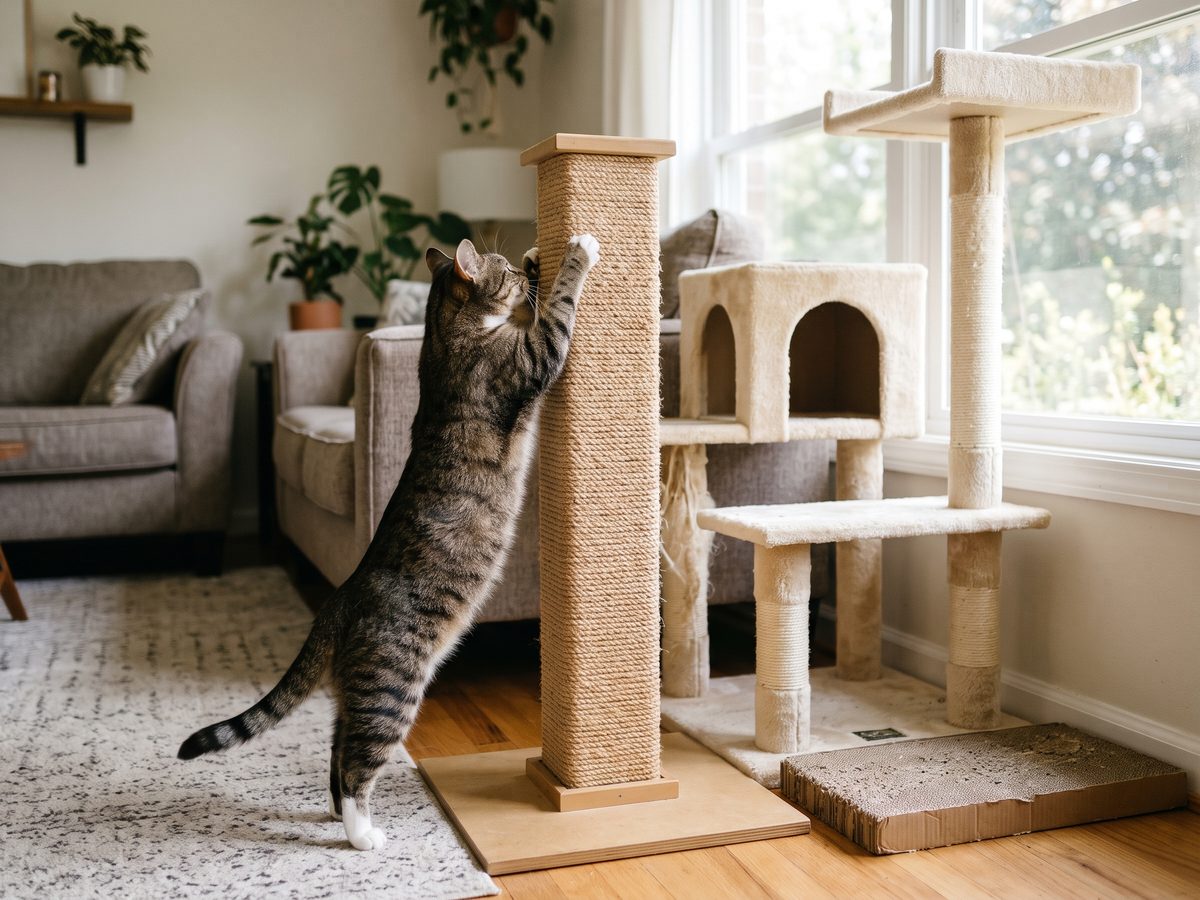
Multi-Level Cat Trees & Towers
A multi-level tree gives a cat several perch heights to choose from, letting a more confident cat claim the top platform while a shyer housemate settles for a lower one, which matters wherever several cats share a home, since perch access doubles as a way to avoid conflict.
Happi N Pets and Amazon Basics both sell a wide range of tower sizes and styles, from compact models suited to a small apartment to large, multi-platform towers built for several cats sharing one household. A wide, weighted base matters more than height once a tower gets tall, since a top-heavy design that wobbles under a jumping cat gets avoided regardless of how many platforms it offers. Placing a tower near a window adds a perch and a view in one purchase.
Wall-Mounted Shelves & Cat Walks
Wall-mounted shelves and stepped cat walks let a cat travel and perch along a route that never touches the floor, which suits a small living room or a household without space for a full-footprint tree. Building a shelf system in stages, starting low and adding height gradually, lets a cat learn the route safely instead of being expected to jump a large gap on the first attempt. Secure wall anchoring counts for more with this setup than with a freestanding tree, since a shelf that shifts under a jumping cat's weight is a safety risk no cat trusts twice.
Ending a shelf run at a window gives the same perch-and-view payoff a floor tower offers, without taking up any floor space at all.
Sisal Scratching Posts
A sisal-wrapped post gives a cat a rough, fibrous vertical surface that grips claws well and shreds satisfyingly during a full-body stretch-and-scratch, which is why sisal remains the standard material for vertical scratchers.
Height matters as much as material here, since a post too short for a cat to fully extend upward doesn't deliver the same stretch a taller post does, and a wobbly, lightweight post gets abandoned in favor of a sturdier piece of furniture nearby. Most cat trees already include a sisal-wrapped section built into the base, but a dedicated standalone post placed near a favorite scratching spot on the furniture often works better than expecting one shared post to cover an entire home's worth of scratching urges.
Cardboard Scratchers
A cardboard scratcher lies flat or sits at a slight angle, giving a cat a horizontal or low-angle surface that some cats strongly prefer over any vertical post regardless of how tall or sturdy the post is. Corrugated cardboard wears down faster than sisal and needs replacing more often, but the low cost makes frequent replacement a non-issue, and many cats seem to enjoy a fresh scratcher's texture more than a worn one anyway.
A cardboard scratcher infused with catnip pulls double duty as both a scratching surface and an enrichment item, drawing a hesitant cat toward it faster than an unscented one would. Keeping one near a couch a cat has scratched before often redirects that specific habit within days.
Window Perches & Condos
A suction-mounted or bracket-fitted window perch turns a windowsill into prime real estate, giving a cat a warm spot to watch birds, cars, or the neighbor's dog by the hour, which counts as real enrichment, not just a place to nap. Weight capacity deserves closer attention here than with most cat furniture, since a perch rated for a lighter cat can fail under a larger one, and checking that rating against your cat's actual weight avoids a startling fall.
A window condo takes the same concept and encloses it with padded walls, adding a sense of security some cats prefer over an open perch exposed on all sides. Cleaning suction cups regularly keeps the seal strong enough to hold weight reliably as the months of regular use add up.
Vertical vs Horizontal Scratchers: Why Cats Need Both
Scratching serves several purposes at once: shedding the outer claw sheath, marking territory with scent glands in the paw, and stretching muscles along the back and shoulders, and a cat's preferred angle for doing all three varies from cat to cat.
A cat that stretches tall against a doorframe clearly favors vertical scratching, while one that digs at a rug or the base of a couch is showing a horizontal preference instead, and offering only one orientation leaves that second instinct with nowhere appropriate to go. Providing at least one option of each orientation, instead of betting that one scratcher style will satisfy every cat under the roof, heads off far more furniture damage than doubling up on the same style twice.
Related Reading
- Stopping sofa scratching: placement, deterrents and patience.
- Multi-cat harmony: why height keeps the peace.
- Maine Coon care: sizing a tree for a big cat.
- Browse all Cats pages
Frequently Asked Questions
Does buying a scratcher actually keep a cat off the couch?
A scratcher redirects the behavior; it doesn't remove the instinct, and picking the right spot for it matters no less than which scratcher gets chosen, since a post tucked in a rarely used room gets ignored in favor of the couch a cat walks past every day. Placing at least one scratcher near the furniture currently being scratched, with the couch made temporarily less appealing, gets better results than the post alone.
How tall does a cat tree need to be?
There's no fixed height requirement, but a tree tall enough that a cat can look down over the whole room from the top platform, generally chest-height or taller on a standing adult, satisfies the vertical-territory instinct better than a low, single-level model. A sturdy, wide base matters more than height alone, since a top-heavy tree that wobbles or tips discourages use regardless of how tall it is.
My cat ignores the tree and scratches the carpet instead. Why?
Carpet offers a horizontal scratching surface, and some cats simply prefer scratching flat, regardless of what's on offer vertically. Adding a horizontal cardboard scratcher alongside the vertical post or tree often solves this instead of trying to force a preference the cat doesn't share.