Cat Toys
Play satisfies a real predatory drive in a cat, not just boredom, and the toy shelf on Amazon splits along the same lines that drive naturally follows: stalking and chasing, pouncing on something that moves unpredictably, and eventually catching and holding a prize.
A wand toy simulates the first two stages with a human controlling the movement, a motorized toy automates that same unpredictable movement without a person attached, and a puzzle feeder channels the same drive toward getting a food reward out of a container. Matching the toy to what your cat responds to, instead of assuming one style fits every personality, gets far more out of playtime.
This page sorts toys by how they engage that play drive: wand and teaser toys, springs and crinkle toys, tunnels, motorized and circuit toys, puzzle feeders, catnip and silvervine toys, and a clear look at laser pointers and why they need a catchable toy to finish the job.
Wand & Teaser Toys
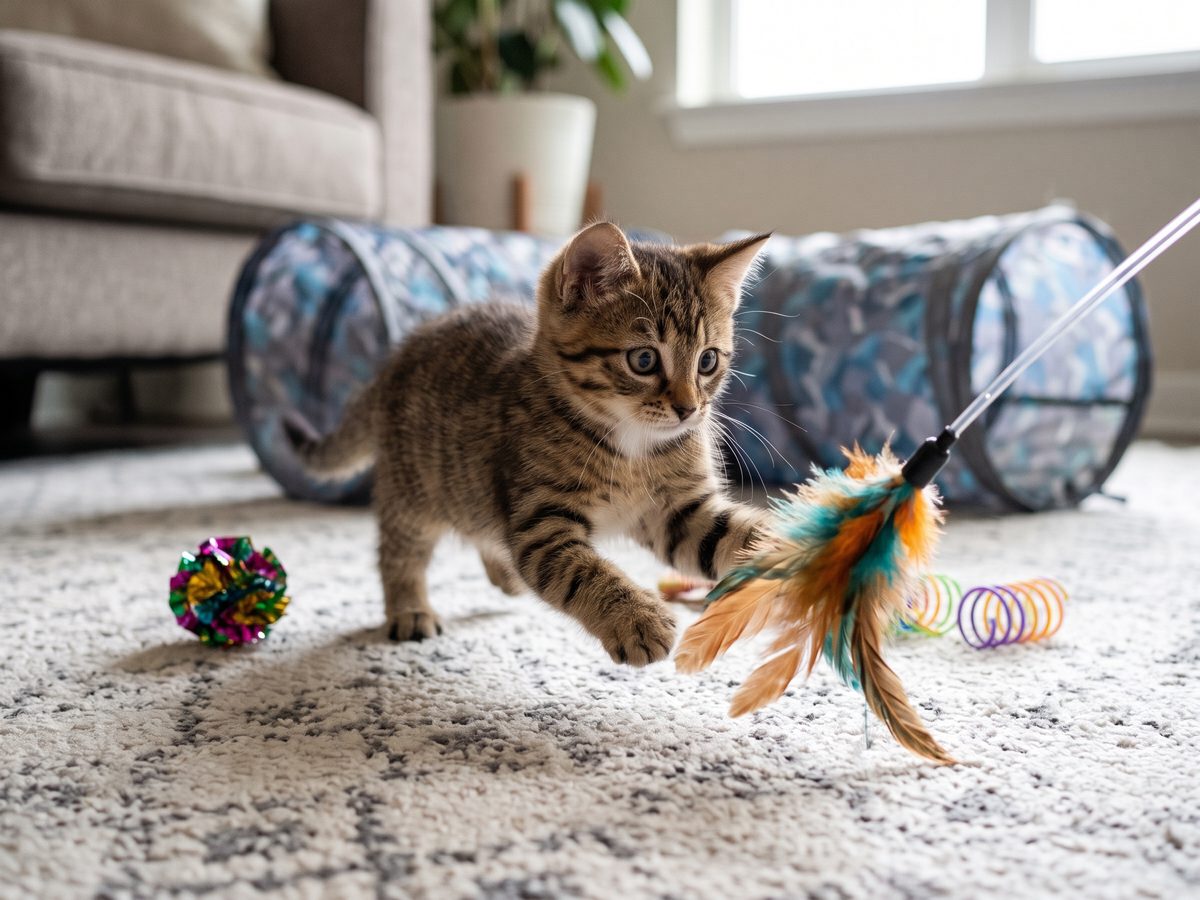
A wand toy puts a feather, fabric strip, or small toy on the end of a flexible rod, letting an owner mimic prey movement in a way no stationary toy can replicate. Da Bird built a long-standing reputation around this exact category, with a feather attachment that spins and flutters realistically when whipped through the air.
A wand toy also builds real interaction into playtime, which matters for bonding in a way a toy left on the floor for solo play can't quite match. Because the string, feather, or small attached piece is a real swallowing and entanglement risk, a wand toy should be put away after each session, not left out for unsupervised access.
Springs & Crinkle Toys
A coiled plastic spring skitters unpredictably across hard flooring when batted, which triggers a strong chase response in many cats purely from the erratic, unrepeatable movement pattern. A crinkle toy adds a loud, papery sound to that same batting-and-chasing motion, appealing to cats that respond as much to auditory stimulation as to visual movement. Both toy types work well for solo play since neither needs a person actively operating them, making them a reasonable option to leave out between supervised sessions.
Buying several at once and rotating which ones stay accessible keeps a cat from losing interest in the same handful of toys sitting out day after day.
Tunnels & Hide-and-Chase Toys
A collapsible fabric tunnel gives a cat a place to hide, ambush, and dash through, tapping into the same instinct that makes a cat pounce out from behind furniture during a burst of nighttime energy. Multiple openings let a cat dart in one side and out another mid-chase, which keeps the game going better than a single-entry tunnel does.
Crinkle material built into the tunnel walls adds sound feedback during a dash-through, and a tunnel with a peek-hole cut into the side gives a hiding cat a spot to watch from without fully committing to coming out. Folding a tunnel down between sessions keeps it from turning into a permanent floor fixture.
Motorized & Circuit Toys
A motorized toy moves on its own, unpredictable schedule, which keeps a cat engaged during the hours an owner isn't available to run a wand session. Cheerble's ball-style toys change direction automatically when they bump into an obstacle, mimicking prey behavior without any human involvement, and Catit's circuit-track toys send a ball looping continuously around a fixed course a cat bats at from any angle.
Battery life and noise level vary meaningfully between models, so checking reviews for both before buying avoids a toy that gets shut off within a week for being too loud. These toys suit a home-alone cat especially well, though they still do their best work topping up real interactive play, not standing in for it entirely.
Puzzle Feeders for Play-Drive
A puzzle feeder makes a cat work for a portion of its food or treats, either by batting a ball-shaped feeder around until kibble falls out or by working through a maze-style tray designed to slow down a fast eater. This channels the same problem-solving and hunting drive that toys satisfy through chase, but aims it at food instead of a toy, which works especially well for an indoor cat with plenty of energy and not enough outlet for it.
Starting with an easier puzzle level and increasing difficulty gradually keeps a cat engaged instead of giving up in frustration on a puzzle too hard to solve on the first try. Rotating between a few different puzzle styles keeps mealtime interesting.
Catnip & Silvervine Toys
A toy infused with catnip or silvervine combines a physical object to bite, kick, and wrestle with a scent that triggers rolling and rubbing in most cats, making it a reliably engaging solo-play toy category. A stuffed kicker toy shaped to be grabbed with front paws and kicked with back legs lets a cat act out a full predatory sequence against something soft.
Refillable catnip toys with a pouch or pocket let an owner freshen the scent once the original infusion fades, extending a toy's useful life well beyond a one-time treated toy. Rotating catnip toys in and out, instead of leaving the same one out constantly, helps preserve a cat's response to the scent over time.
Laser Pointers: The Catchable-Toy Rule
A laser pointer triggers intense chasing because the moving red dot mimics prey perfectly right up until the moment a cat tries to actually catch it, which never happens, since there's nothing physical there to grab. Repeated sessions that end this way, with the chase always unresolved, may leave a cat frustrated instead of satisfied, and some owners notice their cat staring at walls or lights looking for the dot.
The fix is straightforward: close out every laser session with a wand toy or something solid the cat can pounce on and hold, handing the hunting sequence the payoff the dot alone never delivers. A laser used this way, paired with a real toy at the finish, avoids the frustration problem entirely.
Related Reading
- Play and the hunt sequence: how to run a play session.
- Indoor cat enrichment: a full week's routine.
- Bengals and high-energy cats: when one toy isn't enough.
- Browse all Cats pages
Frequently Asked Questions
What amount of daily play does an indoor cat actually need?
Two or three short sessions a day, each lasting several minutes of real chase-and-pounce activity, does more for an indoor cat's wellbeing than one long session or none at all. A cat that seems bored, overweight, or prone to nighttime zoomies is often simply under-stimulated during the day.
Is it safe to leave wand toys out for unsupervised play?
No, a wand toy's string or feather attachment is a real swallowing and entanglement risk when left unsupervised, so put it away after each play session. Motorized toys and puzzle feeders without loose string attachments are generally safer to leave out.
Why does my cat lose interest in a laser pointer so fast?
A laser dot can never be caught, and a cat that never catches anything eventually loses motivation or becomes frustrated by the chase with no resolution. Closing every laser session out with a toy the cat can grab and hold hands the hunting sequence the finish it's missing.