What Keeps a Bengal or Other High-Energy Cat Out of Trouble?
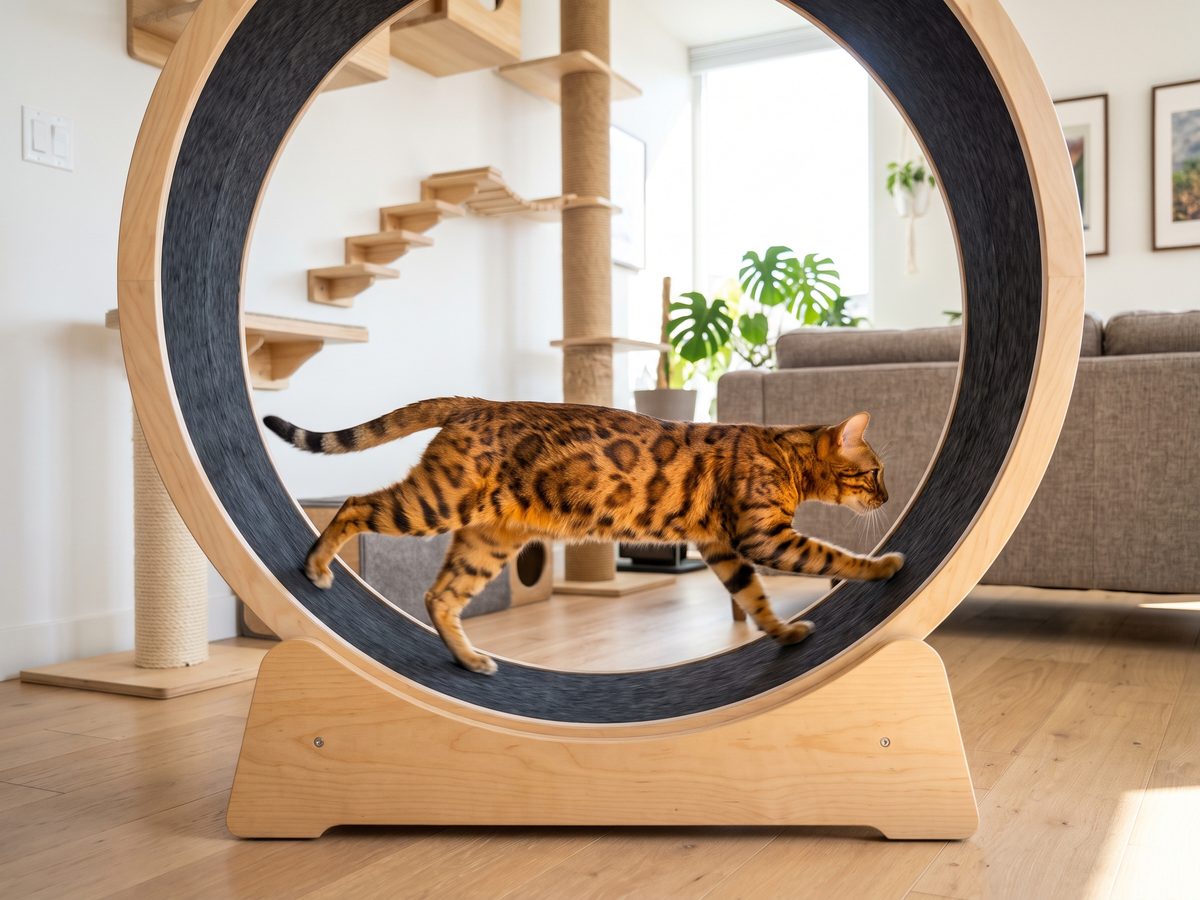
Building an enrichment setup works best tackled roughly in this order.
- Establish vertical territory first with trees, shelves, and window perches at multiple heights.
- Add a cat wheel once the cat has vertical options, introducing it gradually with treats and patience.
- Switch mealtime to puzzle feeders to add mental work and slow down fast eating.
- Begin harness training indoors in short sessions before ever attempting a walk outside.
- Rotate toys weekly to keep novelty in the mix once the core setup is in place.
Vertical Territory First
A high-energy cat wants to survey a room from above, and multiple climbing and perching spots at different heights give that instinct somewhere to go besides the top of a refrigerator or a curtain rod. Spreading perches across several windows and walls, instead of one tall tree in a corner, opens up more of the home as usable territory, which matters more for an active breed than for a cat content to sleep most of the day.
Building vertical options before adding a wheel gives a foundation the rest of the setup builds on, since a cat comfortable moving through vertical space explores new equipment with more confidence. For comparison, plenty of laid-back domestic shorthairs and moggies are perfectly content with a single window perch, so a Bengal's drive for vertical space is a real breed trait, not just typical cat behavior scaled up.
The Cat Wheel: Burning Off Real Energy
A cat exercise wheel, similar in concept to a hamster wheel scaled up, lets a cat run in place at whatever pace it chooses, burning energy that a small living space otherwise has nowhere to absorb. Introducing a wheel gradually, luring a cat onto it with treats or a favorite toy instead of expecting immediate use, works far better than leaving a brand-new piece of large equipment in a room and hoping curiosity takes over on its own.
Not every cat takes to a wheel, and that's fine: it's one enrichment option among several, not a required piece of gear for every household. A stable base and a running surface sized for the specific cat matter for safety far more than any particular brand name does.
Puzzle Feeders for Mealtime Drive
A puzzle feeder turns a meal that would otherwise disappear in under a minute into an activity requiring batting, rolling, or working a paw into a compartment to release kibble, which suits a food-motivated, high-energy cat especially well. Starting with an easy puzzle and working up to a harder one prevents the frustration of a design that's too advanced right out of the gate, something that can turn a cat off puzzle feeding entirely if the first experience goes poorly.
Splitting daily food across a puzzle feeder and a regular bowl, instead of switching entirely overnight, eases the transition for a cat used to fast, easy meals. Beyond slowing down eating, the mental work required gives this breed's problem-solving drive somewhere to spend itself a couple of times daily.
Harness Training for Safe Outdoor Time
A well-fitted cat harness, introduced indoors in short, low-pressure sessions before any outdoor attempt, lets a high-energy cat experience supervised outdoor time while sidestepping the dangers unsupervised roaming brings with it. Building comfort in stages (wearing the harness indoors first, then standing outside on a porch, then a short walk on a quiet street) beats forcing a cat straight into full outdoor exposure on day one.
Cats generally don't walk on a leash the way dogs do, so following the cat's pace and letting it explore, instead of leading the way, suits this training better than a dog-walking mindset. A cat that never warms up to a harness isn't a failure; supervised catio time or window access can fill the same outdoor-interest need without the leash.
Building the Enrichment Stack
A tall, multi-level cat tree and a few wall-mounted shelves cover the vertical-territory piece most high-energy cats need first, and a cat exercise wheel gives an athletic cat somewhere to burn energy a small home otherwise can't absorb. A puzzle feeder turns mealtime into mental work instead of a thirty-second event, and a well-fitted walking harness with a matching leash opens up supervised outdoor time once training is underway. None of this gear works instantly. Consistent daily use is what turns any of it from a purchase into an actual habit that changes behavior.
Frequently Asked Questions
Space needs and harness training generate most of what owners ask about this kind of cat.
Is a Bengal too much cat for an apartment?
Not necessarily, but an apartment setup needs real vertical space and daily interactive play to work well, since square footage matters less than how that footage gets used. A Bengal stuck in tight quarters with nothing to climb and little playtime develops behavior problems far more readily than one given the same lack of enrichment in a sprawling house.
What's a realistic timeline for training a cat to walk on a harness?
Somewhere between a few weeks and several months. It hinges on the individual cat and how consistent the training sessions turn out to be. Rushing the process by skipping the indoor-wear stage tends to backfire, producing a cat that fights the harness instead of one gradually getting used to it.
Are cat wheels safe, or do cats get hurt using them?
A wheel sized correctly for the cat, with a stable base and enough running surface, is safe for most cats once they're introduced to it gradually, similar to introducing any new piece of equipment. Problems tend to come from an undersized wheel or one that wobbles, not from the concept of a cat wheel itself.
Do puzzle feeders actually slow down a fast eater?
Yes, a puzzle feeder that requires batting, rolling, or working a paw into a compartment physically limits how fast kibble can come out, which naturally slows a cat that normally finishes a bowl in seconds. It also adds a mental task to mealtime that a plain bowl never offers.
Is it true that under-stimulated cats become aggressive?
Not aggressive in every case, but pent-up energy in a high-drive cat commonly turns into behavior owners find frustrating: nighttime zoomies, ankle-attacking, knocking things off shelves, or redirected biting during play. Increasing structured activity often resolves these behaviors faster than any product aimed at correcting them directly.
How much vertical space does a single high-energy cat actually need?
There's no fixed square-footage rule, but multiple levels reaching toward the ceiling, not just one tall tree in a corner, make the biggest difference for a cat that wants to survey a room from up high. Spreading perches across different windows and walls, instead of clustering everything in one spot, gives more real usable territory than a single tall piece of furniture alone.
Related Reading
- Savannah and hybrid cats: early generations and the law.
- Harness training: supervised outdoor time.
- Egyptian Mau: a naturally spotted domestic breed.
This guide covers enrichment and behavior prevention; it isn't veterinary advice. A sudden change in energy level, appetite, or temperament, or aggression that doesn't improve with more structured activity, is worth discussing with your vet before assuming more toys alone will fix it.