How Do You Introduce a Second Cat to Your Home?
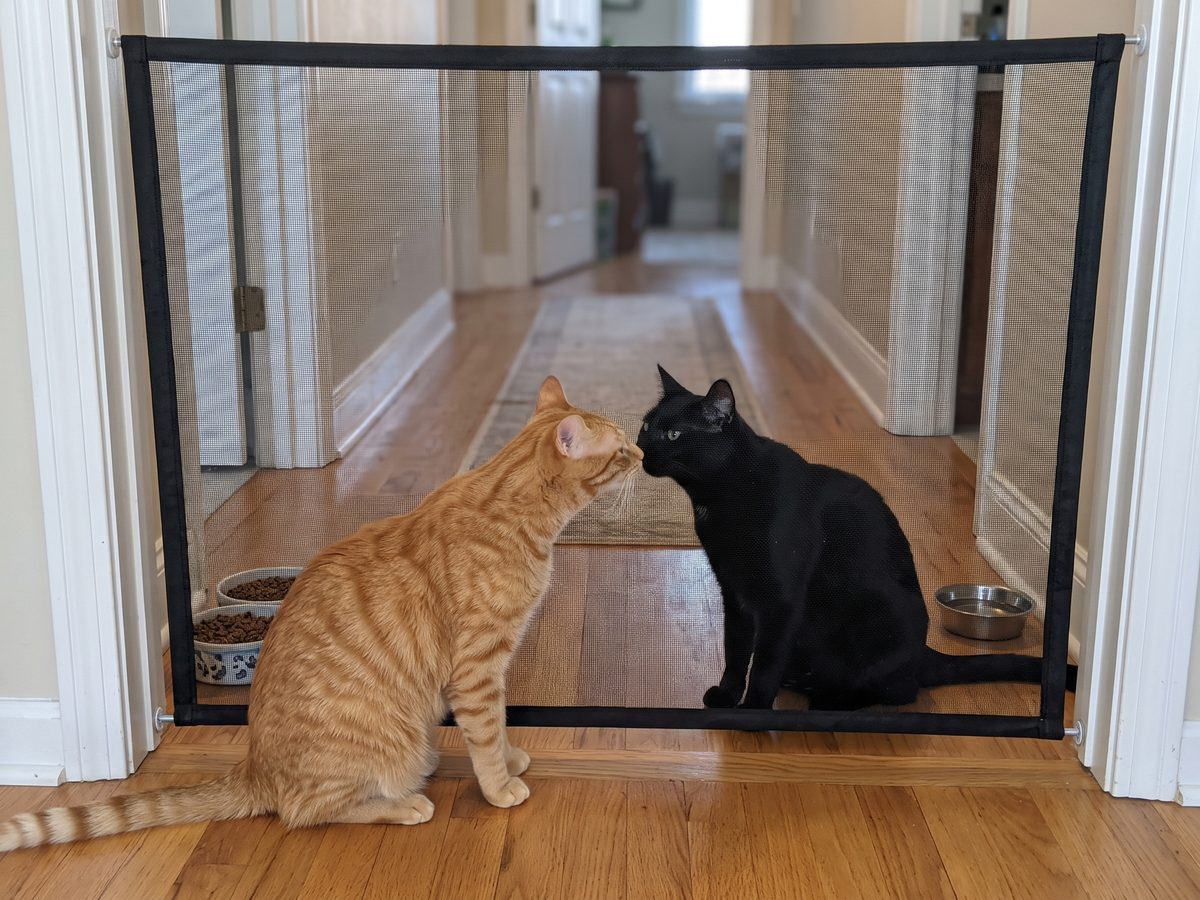
The stages below run in sequence; a setback at any point usually means going back one stage instead of pushing forward.
- Keep the newcomer in a separate base room with its own litter box, food, water, and hiding spots for at least the first several days.
- Swap bedding or a soft cloth rubbed on each cat's cheeks between the two spaces daily, so each cat gets used to the other's scent without a face-to-face encounter.
- Feed both cats simultaneously, each cat on its own side of the closed base-room door, building a positive association between the other cat's smell and a good meal.
- Once both cats eat calmly this way, swap which room each cat has access to for short periods, letting each explore the other's territory scent-first while the other is elsewhere.
- Introduce visual contact through a cracked door, baby gate, or screen door, keeping sessions short and ending them before either cat shows sustained tension.
- Extend visual sessions gradually, watching for relaxed posture (normal blinking, no fixated staring, no flattened ears) before considering a supervised, barrier-free meeting.
- Allow brief supervised time in the same open room, with an easy exit route for both cats, and separate them again calmly before either one reaches its limit.
The "They'll Sort It Out" Myth
Letting two unfamiliar cats meet loose in the same room on day one, on the theory that cats naturally work out their own hierarchy, skips every stage that builds real tolerance and often backfires badly instead. A startled, cornered cat has nowhere to retreat to and no positive association built up yet, so a first encounter under those conditions tends to end in a scared, defensive reaction that both cats then associate with each other going forward. Cats that meet this way sometimes do settle eventually, but many end up in prolonged tension, hiding, or outright avoidance that a slower introduction would likely have prevented from the start.
Reading Readiness Instead of Following a Calendar
No fixed number of days applies to any stage above. The right pace is whatever each individual pair of cats shows through their body language, and forcing progress on a schedule tends to backfire. Calm eating near the shared door, relaxed posture during a sight session, and the absence of prolonged hiding after a session ends are the signals that mean it's time to move forward.
A cat that stops eating, hides for hours afterward, or shows fixated staring and a lashing tail during a sight session isn't ready for the next stage yet, and pushing ahead anyway usually costs more time overall than waiting would have. A naturally cautious breed like the Russian Blue often needs noticeably more time at each stage than this timeline's own baseline pace assumes.
Setbacks Are Normal, Not a Failure
A hiss, a swat through a screen door, or a sudden refusal to eat during a session that had been going well doesn't mean the introduction has failed. It usually means the process moved a stage too fast for one of the cats involved. Returning to the previous stage for several more days before trying again is the standard response, not a sign to give up on the pairing entirely. Owners who expect a perfectly linear progression often abandon a workable introduction after a single rough session that a brief step back would have resolved.
The same patience-first logic applies well beyond cats. Our bonding two rabbits guide walks through a differently staged version of the same principle for a very different species.
Gear That Supports a Slow Introduction
A second full set of litter box, food bowls and water, kept entirely separate from the resident cat's setup during the base-room stage, removes one of the biggest early flashpoints before it can start. A tall baby gate or a screen door insert lets the sight stage happen safely without either cat squeezing through for an unsupervised early meeting.
Soft cloths kept just for scent-swapping, and a spare bed or perch for the newcomer's base room, round out what this specific protocol depends on; ongoing resource planning for the household once introductions succeed is covered on the multi-cat harmony guide.
Frequently Asked Questions
Timelines and whether a hiss means trouble get asked before anything else about this process.
How long does introducing two cats usually take?
Anywhere from two or three weeks up to half a year, and it hinges heavily on the individual cats involved. A confident resident cat and a calm newcomer might move through the stages quickly, while a nervous pairing can need considerably longer at every step.
Is hissing during the first sight of each other a bad sign?
Not necessarily. A hiss or a swat through a barrier is a normal startled response to a new cat's presence, not proof the introduction has failed. Repeated, escalating aggression across several sessions is the pattern that actually calls for slowing down.
Can I introduce a kitten to an adult cat faster than two adults?
Not necessarily faster, since the adult cat's tolerance still sets the pace regardless of the newcomer's age. A kitten's boundless energy can actually wear on a resident adult, so the same gradual stages apply even when one cat is much younger.
What if the two cats never become friends?
Peaceful coexistence is a realistic and acceptable outcome even without affection between the two cats. Many multi-cat households run smoothly with cats that simply tolerate shared space without seeking each other out, and that's a legitimate finish line, not a failure.
Should the resident cat or the newcomer get the main living space during introductions?
The newcomer typically starts in a separate base room while the resident cat keeps its usual territory, since flipping that arrangement adds a second stressor on top of the introduction itself. The newcomer's space expands gradually as the process progresses.
How do I know when to move to the next stage of introductions?
Relaxed body language on both sides at the current stage (normal eating, no prolonged hiding, no fixated staring) signals readiness to progress. Moving on before that happens tends to trigger the exact setback the slow pace is designed to avoid.
Do pheromone diffusers help during cat introductions?
Some owners find them a useful supporting piece of the process, particularly during the scent-swap and early sight stages. This site's page on pheromone diffusers covers what the evidence supports and where placement makes the biggest difference.
Related Reading
- Multi-cat harmony: life after introductions.
- Cat body language: reading the signals.
- Pheromone diffusers: what they can add.
Ongoing aggression that doesn't ease even with a slow, staged approach calls for a qualified cat behaviorist, not more time repeating the same steps. If the resident cat's appetite drops off, it starts hiding for long stretches, or a previously reliable litter box gets skipped once the newcomer arrives, a vet visit belongs on the schedule too, because stress can bring out health problems that were already there.