How Many Cats Can Live Together Peacefully?
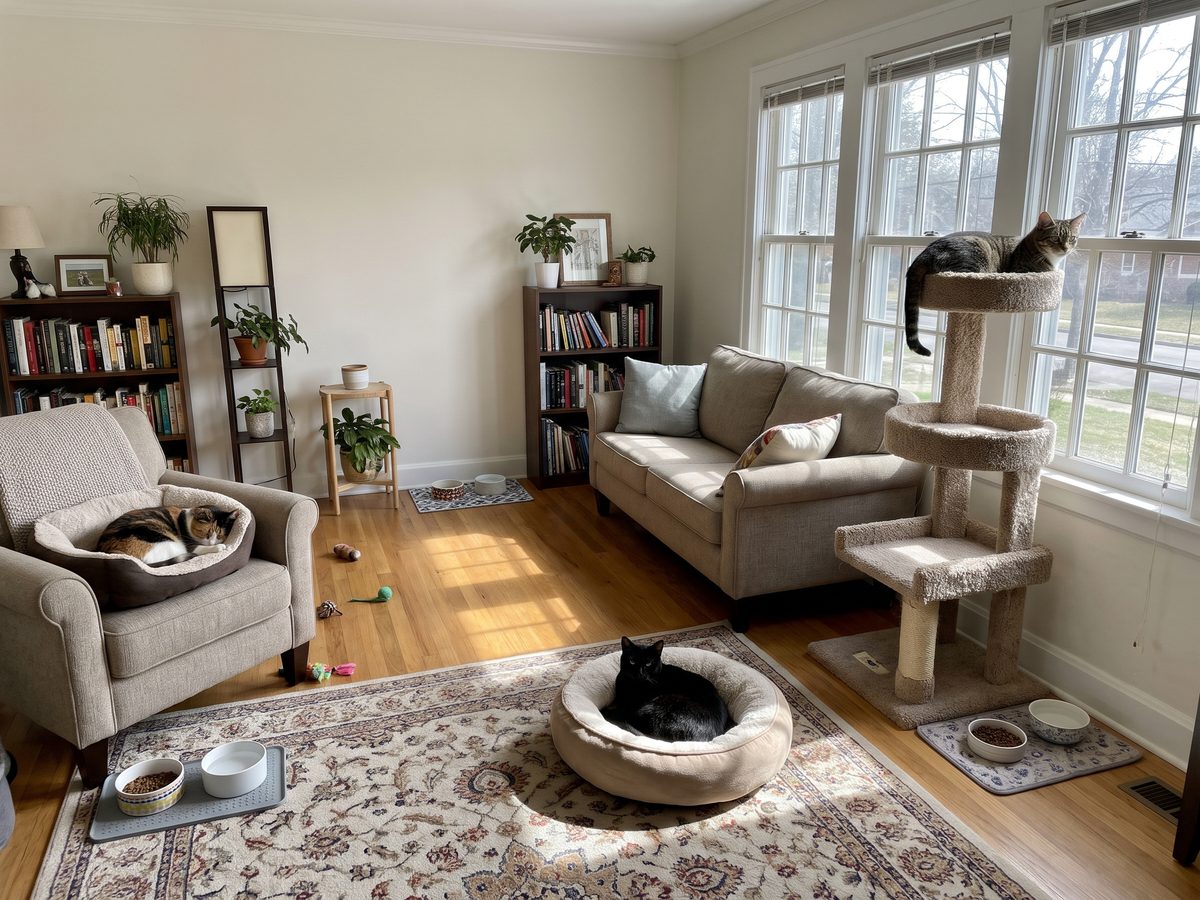
These are the resources most likely to create tension if the count runs short.
| Resource | Baseline guideline | Where it bends in a small home |
|---|---|---|
| Litter boxes | Cat count plus one, spread across rooms | Boxes tucked into different corners, not lined up together |
| Feeding stations | One per cat, apart from each other | Elevated or separated bowls where floor space is tight |
| Resting spots | More spots than cats, at varied heights | Wall shelves substitute for multiple floor beds |
| Vertical territory | Multiple perches reachable from different rooms | One tall tower plus a couple of window perches |
The Resource Rule and Where It Bends
The guideline behind most multi-cat resource planning is straightforward: provide one more of each key resource than the number of cats sharing the home, so no single item ever becomes the one thing two cats have to compete over. In a spacious house that's simple to apply literally, but a small apartment often can't fit a strict duplicate count of everything, and that's where the principle bends without breaking.
Spreading fewer resources across more locations, using vertical space to multiply a small floor footprint, and staggering feeding times can achieve the same underlying goal of reducing contested bottlenecks even without hitting the exact numeric guideline.
Reading Tension in Plain Terms
Ongoing tension between cats rarely announces itself as outright fighting. It shows up as one cat avoiding a room, a sudden reluctance to use a particular litter box, eating more cautiously or watchfully than before, or a general pattern of one cat controlling access to a hallway or doorway that others need to pass through. These cues matter more than a single hiss or swat, which can happen even in generally settled households.
Management responses to early signs (adding a resource, changing its location, or opening an alternate route around a contested chokepoint) often resolve mild tension before it escalates into anything more serious.
Feeding and Litter Geography
Placement rivals quantity in importance here: scattering litter boxes into separate rooms instead of lining them up in one utility closet gives every cat a route that skips passing a rival entirely, and feeding stations benefit from the same separated layout.
Our litter boxes and automation guide covers the box types and setups that make spreading litter access around a home practical, and pairing that layout with the introduction protocol on the introducing a second cat guide gives a new addition the best odds of settling into an already-established household.
Gear for Spreading Resources Out
Additional compact litter boxes sized to fit awkward corners make it practical to spread litter access across a small home instead of clustering every box in one utility room. Elevated or separated feeding stations reduce the tension that comes from cats eating shoulder to shoulder, and wall-mounted shelves multiply usable resting and vantage space without eating into floor area at all. A second or third scratching post, placed away from the others, spreads that resource the same way litter and food should be spread. None of this replaces watching the cats themselves: gear only works alongside attention to how a specific household is actually using it.
Frequently Asked Questions
A firm ceiling on cat numbers and whether a small apartment can follow the rule at all come up constantly.
Is there a maximum number of cats one home can hold?
No fixed number applies to every household, since space, layout, and the individual cats' personalities matter more than a simple count. A large home with generous resource spread can comfortably hold more cats than a small apartment with the same number crammed into tight quarters.
Do resources need to be duplicated even in a small apartment?
The underlying principle still applies, but the scale bends. In a small apartment, resources spread across different rooms or heights often achieve the same goal of avoiding a single contested bottleneck.
How can I tell if two cats are actually fighting or just playing roughly?
Play generally includes pauses, role-switching, and no vocalizing beyond the occasional chirp, while real conflict involves fixed staring, flattened ears, growling or yowling, and one cat clearly trying to leave while the other blocks it. Watching how a bout ends says more than how it starts.
Does adding a third cat change the resource math compared to two?
Yes, each additional cat raises the baseline resource count and also increases the number of possible tense pairings within the group, which is worth factoring in before adding a cat to an already-settled household. More cats means more relationships to manage, not just more mouths to feed.
Should litter boxes and feeding stations be kept in the same room?
Spreading them across different rooms generally works better than clustering everything together, since a single room housing every resource turns into one contested space instead of several separate, lower-pressure ones. Cats also tend to prefer eating away from where they eliminate.
When does tension between cats need a professional?
Ongoing avoidance, a cat that stops using certain rooms, weight loss from resource guarding at the food bowl, or any actual fighting are signs that resource adjustments alone likely won't resolve things. A qualified cat behaviorist can assess your household in person.
Related Reading
- Introducing a second cat: starting off right.
- When neighbors' cats visit: tension from outside.
- Cat body language: spotting tension early.
A cat withdrawing from food, water, or the litter box because of ongoing tension with a housemate needs a veterinary check, since stress-related appetite and litter changes can quickly become medical concerns of their own. Any actual fighting that draws blood, or tension that resource changes haven't touched after a real effort, calls for a qualified cat behaviorist.