What Does an Indoor Cat Need to Thrive?
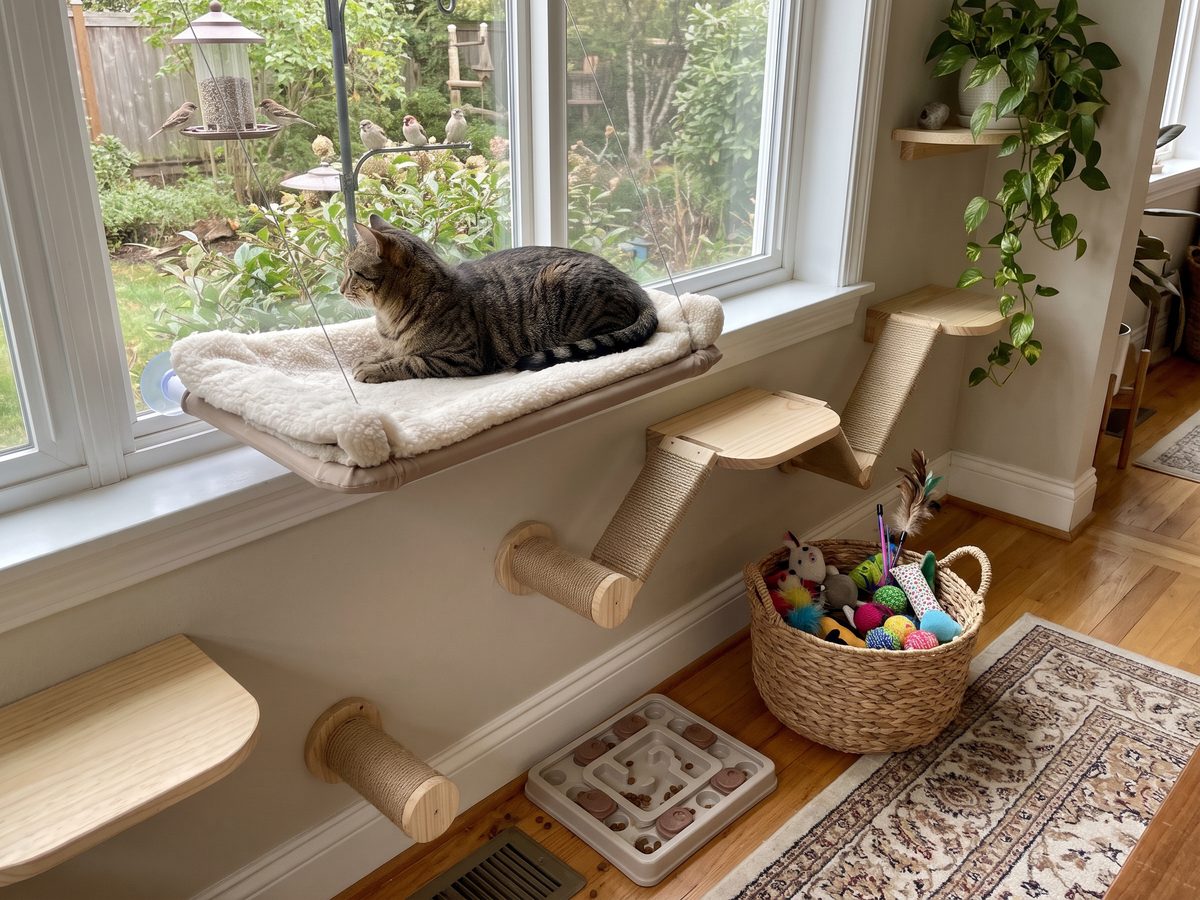
These five pillars work together; leaning on only one or two leaves the others' gap unfilled.
| Pillar | What it satisfies | How it stays alive day to day |
|---|---|---|
| Vertical territory | Surveying and claiming space from height | Multiple perches at multiple heights, kept accessible |
| Toy rotation | Ongoing novelty in what's available to play with | Swapping most toys out of sight every week or two |
| Window time | Passive stimulation and something to watch | A reliable perch at a window with outside activity |
| Food puzzles | Problem-solving drive channeled at mealtime | Used for at least part of a regular meal, not just as a rare treat |
| Scent and novelty | Sensory variety beyond sight and movement | New, cat-safe smells or objects introduced occasionally |
Vertical Territory Is a Principle, Not a Purchase
A cat's sense of security and status comes partly from having somewhere elevated to retreat to, and that need is about access and distribution, not the size of any single cat tree. A household with one tall tower in a corner and nothing else still leaves most of a home at floor level, while a few smaller perches, shelves, or window platforms spread across several rooms give a cat elevated options wherever it happens to be.
Our cat trees & scratchers guide covers the actual furniture and shopping side of vertical space; the point here is how that furniture earns its keep inside a living routine, instead of sitting as a one-time purchase gathering fur.
Toy Rotation Beats Buying More Toys
A cat that has seen the same four toys scattered on the floor for months has effectively stopped noticing them, and buying a fifth toy rarely fixes that on its own. Rotating a small working set (putting most toys away and swapping in a different handful every week or two) restores novelty without spending anything further, since a toy a cat hasn't seen in a month reads as new again.
Every toy style worth stocking for this rotation is sorted on the cat toys page. The habit of rotating what's already in the house does more for long-term engagement than the toy box's total size ever will.
Window Time and Food Puzzles as Daily Activity
A reliable perch at a window overlooking any outside activity (traffic, birds, passing people) gives a cat hours of low-effort passive stimulation that costs nothing beyond the initial setup, and it pairs well with the more active pieces of a routine instead of replacing them.
Food puzzles do a similar job for the problem-solving side of a cat's day: turning part of a regular meal into a small working task channels the same drive a hunt would satisfy. Neither piece has to be fancy. A plain window perch and a basic puzzle used every day beat an impressive setup that mostly sits idle.
Scent Novelty and a Repeatable Play Schedule
Introducing a new, cat-safe scent occasionally (a fresh cardboard box, a paper bag with the handles cut off, a pot of cat grass) adds a layer of sensory variety that toys and height alone don't cover, and it takes almost no effort to work into an existing routine.
What ties every pillar together is a repeatable daily schedule, not sporadic bursts of attention: a short active session using the hunt-sequence protocol, a puzzle at a mealtime, and passive access to window and vertical space the rest of the day. Doing it daily beats running one long, occasional session by a wide margin.
This matters even more for a naturally placid breed like the Ragdoll, which won't reliably start any of this on its own. It matters just as much, the other way round, for a breed like the Abyssinian, whose height-seeking, near-constant drive turns an under-built routine into redirected mischief instead of quiet boredom.
What This Program Draws On
This page is the program that ties existing gear together, not a new shopping list. The vertical furniture itself lives on the cat trees & scratchers page and the toy range for rotation lives on the cat toys page. The two items worth calling out on their own here are a food puzzle feeder, since it anchors the mealtime pillar directly, and a simple window perch, since it's the cheapest single addition most indoor cats are missing. Buying either one does nothing without the rotation and schedule habits described above sitting around it.
Frequently Asked Questions
Whether owned gear alone counts as enrichment is the question that comes up first and most.
Isn't buying a cat tree and some toys enough enrichment on its own?
Owning the gear is a start, not the finish line. A cat tree gathering dust in a corner or a toy box nobody reaches for anymore delivers little by itself; a rotation and a schedule wrapped around that gear is what turns equipment into ongoing enrichment.
How often should toys actually be rotated?
There's no fixed schedule that suits every cat, but putting away most of the toys and swapping in a different small set every week or two keeps novelty high without needing to buy anything new. A cat that has stopped noticing a toy at all is the clearest sign it's due for a rotation.
Does a food puzzle count as real enrichment, or just a feeding gadget?
A food puzzle earns its place as real enrichment when it turns part of a meal into a working problem, not an instant reward, engaging the same problem-solving drive a hunt would. Used only occasionally, or left as the sole source of stimulation, it does far less than it could as one piece of a wider routine.
My cat just sleeps by the window all day. Is that enough enrichment?
Window time is a valuable part of the picture, especially with outside activity to watch, but it works best alongside active play and vertical space, not instead of them. A cat getting only passive window time and nothing else is still missing the physical and problem-solving side of the routine.
How much vertical space does one cat actually need?
There's no fixed figure, but the goal is having more than one elevated resting spot, at more than one height, reachable from several points around a room. A single cat tree in one corner falls short of that goal far more than a few smaller perches spread across a home would.
Is scent-based enrichment worth the effort compared to toys and climbing?
It's an underused layer that adds variety for next to no cost, since novel, cat-safe scents bring something a toy rotation alone can't provide. It works best layered onto the physical and problem-solving pieces of a routine, not swapped in as a substitute for either one.
How long should a daily enrichment routine take?
A workable routine fits into a normal day without much disruption: a couple of short active-play sessions, a puzzle at mealtime, and passive access to window and vertical space the rest of the day. The consistency of showing up daily matters more than the length of any single session.
Related Reading
- Indoor or outdoor?: the bigger decision.
- Play and the hunt sequence: the daily session.
- Cat trees and scratchers: vertical space.
A cat that walks away from an enrichment routine it previously enjoyed, or that stays withdrawn no matter what's on offer, deserves a trip to the vet before boredom gets the blame. Pain, illness, and stress can each flatten a cat's interest in play and exploration in ways no amount of enrichment will fix on its own.