Cat Play and the Hunt Sequence, Explained
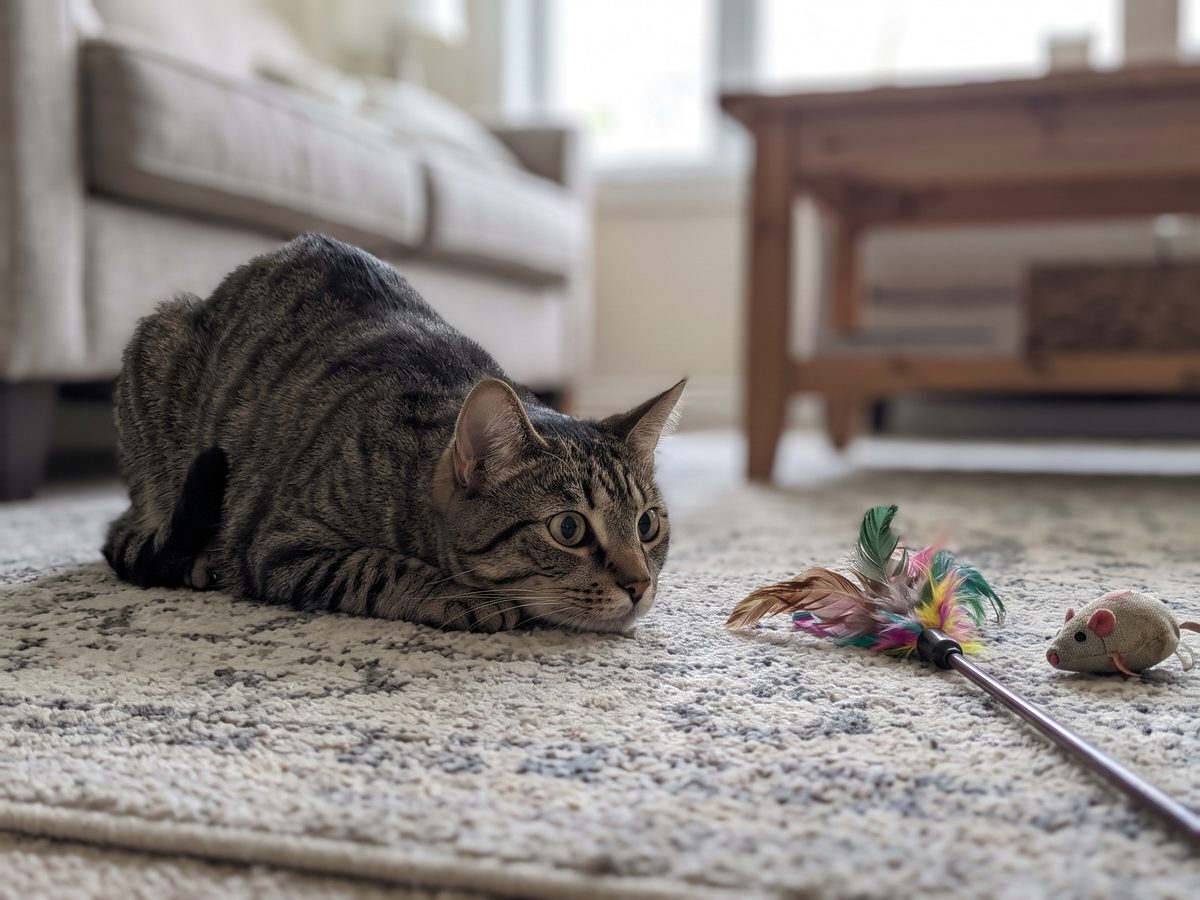
A wand-play session that respects the full sequence follows roughly this order, every time.
- Let the toy sit still first, just out of easy reach, so the cat has to notice and fixate on it before anything moves.
- Twitch the toy briefly, then pause. Short bursts of motion read as prey far better than one continuous drag across the floor.
- Once the cat's weight shifts into a crouch, keep the toy low and slow to invite the stalk instead of spooking it into retreat.
- Let the chase build across a few feet of open floor, changing direction the way a fleeing prey animal would.
- Slow the toy right down as the cat closes in, giving it a real chance to make contact instead of snatching the toy away at the last second.
- Allow the catch to happen and let the cat hold, bite, and kick the toy briefly before it gets reset for another round.
- Close the whole session by handing over a treat or part of a meal, so eating finishes the sequence the way a real hunt would.
The Sequence Behind Every Play Session
What looks like random pouncing on a moving toy is a fixed behavioral sequence: a cat stalks a target it has spotted, chases once the target moves, pounces and catches it, delivers a kill-bite, then eats. Each stage sets up the next, and a cat interrupted partway through (chasing but never catching, for instance) doesn't simply lose interest the way a person might.
Instead, that unfinished sequence tends to resurface later as pacing, vocalizing at the toy box, or pouncing on ankles and other moving targets around the house. Recognizing which stage a cat is stuck in accounts for plenty of what otherwise looks like unrelated household mischief.
Why Laser-Only Play Leaves Cats Frustrated
A laser dot walks a cat through stalk and chase convincingly, then removes the one stage that makes the whole sequence feel complete: there is nothing to catch, because a beam of light has no substance. A cat that plays with a laser every day and never anything else can end up chasing without resolution session after session, and some owners notice restlessness or pouncing on light and shadow long after the laser has been put away.
The fix isn't dropping the laser. It's never using one alone. Following any laser session with a real, catchable toy hands the sequence the ending it was missing, and the cat toys guide covers the wand and catchable toys that pair well with it.
Reading Play That's Tipping Into Overstimulation
A cat deep in the chase stage sometimes crosses from focused hunting into overstimulation, and the signs are worth learning apart from ordinary play intensity: dilated pupils held wide even in bright light, a tail lashing hard, not flicking, ears pinned flat instead of forward, and skin rippling along the back.
At that point, the better move is stopping the session and letting the cat calm down instead of pushing through to a catch, since a cat this worked up may redirect a bite toward a hand that gets too close. A short pause, then restarting at a slower pace, usually settles things faster than trying to finish the sequence at full speed.
Kittens, Adult Cats, and Solo Play Between Sessions
Kittens rehearse the same stalk-chase-pounce-bite sequence during rough-and-tumble play with littermates, which is exactly why that play looks harder-edged than an adult cat's hunting style: bite pressure hasn't been calibrated yet. An adult cat playing alone, without a person running the wand, still benefits from toys that let it complete a version of the sequence solo: something that moves unpredictably when batted, or a puzzle feeder that turns eating into a small working problem. Neither substitutes fully for a person-led session, but both help fill the gap on a day when a full wand routine doesn't happen.
A high-drive breed such as the Siamese or an Oriental tends to notice a skipped session fastest, often turning that pent-up energy into louder demands.
Gear Built for Finishing the Sequence
The single most useful purchase for this protocol is a wand toy with a catchable attachment, since a session with nothing to actually grab leaves the sequence unfinished no matter how strong the chase itself was.
A small, soft toy kept in reserve gives the catch stage something to hold and kick once the wand toy has done its job of building the chase. A pinch of training treats or a spoonful of a regular meal closes the loop the way a real hunt would, and neither needs to be anything special beyond what the cat already eats. Browse the full wand, motorized, and catchable-toy range on the cat toys page; the short list here covers only what this specific protocol depends on.
Frequently Asked Questions
Hand-biting during play and how long a single session should run get asked more than anything else here.
Why does my cat bite my hand once a play session winds down?
A hand makes a poor final target because it's attached to a person, not a toy. Once the chase escalates toward the pounce-and-bite stage, teeth land on whatever is closest. Ending every session with a toy in hand, not fingers, keeps that bite where it belongs.
Is it bad for a cat to catch and 'kill' a toy repeatedly?
No, that's the sequence working as intended. A toy has no welfare stake in being pounced on, and letting a cat finish the kill-bite stage on an object, instead of being denied it every time, is what makes play satisfying.
How long should a single play session last?
Most cats lose real interest in a single toy inside ten minutes or so, well before a person tires of holding the wand. Ending on a catch while interest is still high beats dragging a session out until the cat simply walks away.
Why does my cat ignore the toy sometimes and pounce on it wildly other times?
Which toy gets used matters less than how it moves. Fast, erratic, prey-like motion (darting under furniture, freezing, then bolting again) triggers the sequence reliably, while a toy dragged along one slow, straight line rarely keeps a cat's attention.
Should kittens play differently from adult cats?
Kittens rehearse the same stages but with less bite control, which is why littermate play looks rougher than an adult cat's hunting style. A kitten playing solo with a person still needs the session to end in a catch, just with a softer toy and closer attention to teeth on skin.
My cat won't chase anything. Is something wrong?
Some cats simply need the right trigger: a new toy, a different movement style, or a session at a time of day closer to their natural activity peaks. A cat that has always played but stops abruptly is a different matter and worth a veterinary conversation, since pain or illness can flatten interest in play fast.
Does play-fighting with hands teach a cat to bite people?
It can, especially with kittens learning what's acceptable to sink teeth into. A hand that's always holding the toy when the chase resolves never gets rehearsed as the target, so the association simply never forms in the first place.
Can a food puzzle replace wand play?
It covers a separate stage of the sequence. A food puzzle satisfies the working-for-a-meal instinct well, but it doesn't involve the stalk-chase-pounce movement a wand session provides, so most cats benefit from both.
Related Reading
- Cat toys: wands and catchable toys.
- Cats and garden wildlife: play that cuts hunting.
- Night zoomies: evening play timing.
None of this replaces a veterinary visit if play habits change on their own. A cat that used to chase eagerly and stops doing so across several days running, or one that suddenly plays far more roughly or vocally than before, deserves a check-up before the difference gets written off as mood.