Devon & Cornish Rex Care Guide: Coat, Warmth and Food Drive
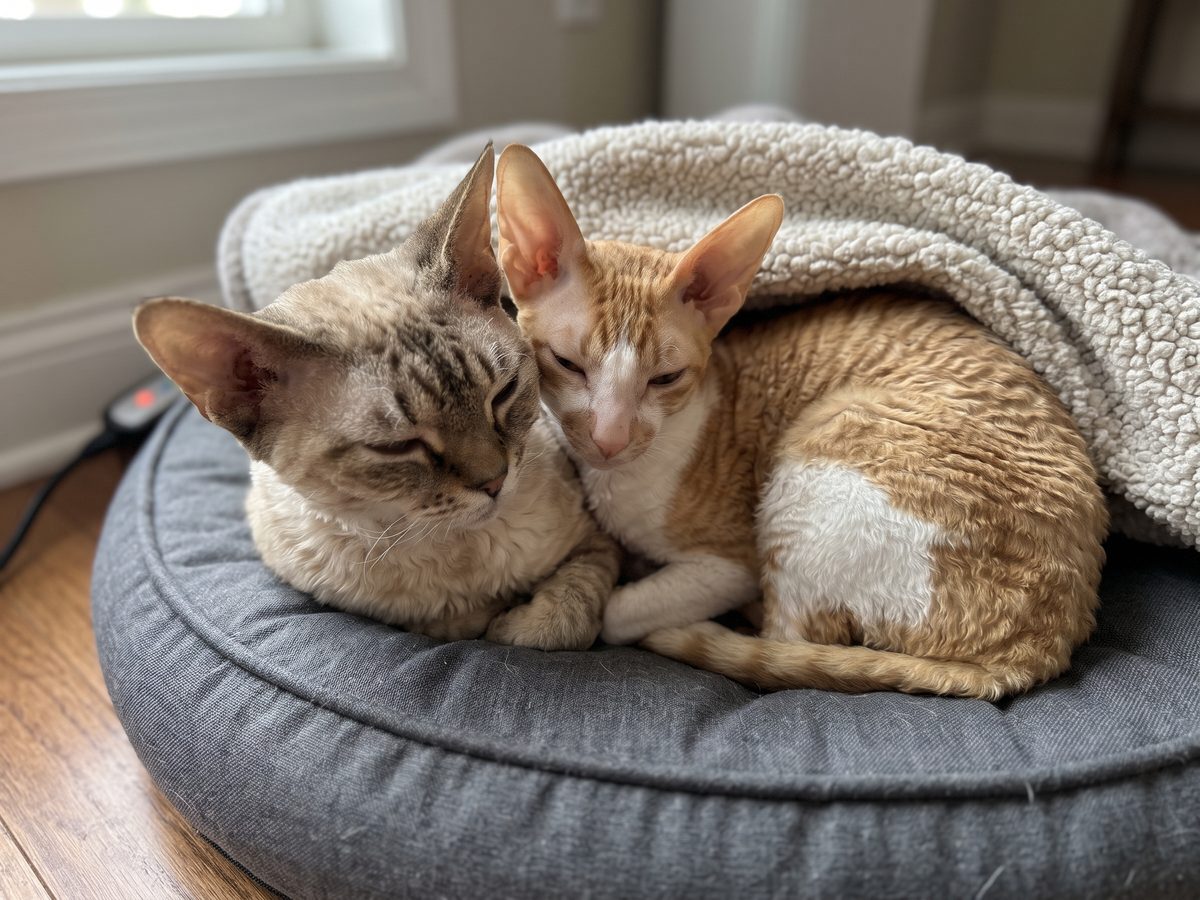
An unusual coat changes more of the care routine than its looks suggest, starting with this table.
| Coat | Warmth needs | Energy | Food drive | Lifespan | Good with |
|---|---|---|---|---|---|
| Short, soft, curled and sparse; not hairless | High, similar to a hairless breed | High, playful and attention-seeking | Strong, portion control matters | About 9–15 years | Active, engaged households |
Who These Two Breeds Suit
An active, deeply people-oriented cat that wants to be wherever you are describes both breeds accurately, from perching on a shoulder to investigating an open drawer. That suits someone glad to have a shadow underfoot most of the day.
Keeping the home comfortably warm and measuring food instead of free-feeding also belong in the plan, since a cat this food-motivated will happily overeat given half a chance. A cold house kept deliberately cool in winter, or anyone hoping for a low-key, hands-off companion, both run against what these breeds are, since chill gets to them in a way a fully coated cat never feels.
Coat and Skin, Gently
The thin, soft, often wavy coat on a Devon or Cornish Rex still counts as real fur, unlike a Sphynx's near-total lack of one, but it's sparse enough that the skin underneath deserves more attention than a densely coated cat's would. A gentle wipe-down with a soft cloth between occasional baths helps manage the skin oils this coat type can't fully absorb the way a fuller coat would, and ears benefit from regular, careful cleaning since wax tends to build up more visibly in this breed.
Nails should be kept trimmed, since a cat this into climbing and exploring puts more wear on furniture and skin alike than a calmer breed does. This site's Sphynx cat care guide covers the fuller hairless-skin routine, and much of that same logic scales down for a rex coat this thin, even though the grooming frequency itself doesn't need to match a fully bare-skinned breed's.
Warmth Needs That Rival a Hairless Breed's
A thin, sparse coat provides only limited insulation, and both breeds seek out warm spots (a sunny windowsill, a heating vent, a person's lap) with a persistence that a fully coated cat rarely shows to the same degree. A heated cat bed, a sweater for a cold house, and keeping the thermostat a touch warmer than a household with a standard-coated cat might otherwise choose all add up to real comfort gains here. A cat visibly shivering or seeking warmth constantly is communicating a real need, not simply being dramatic about the temperature.
A Big Appetite to Manage
Both breeds carry a well-earned reputation for strong food drive, likely tied in part to a naturally higher metabolism that comes with such an active temperament, and that combination makes overfeeding an easy trap for an owner who mistakes constant food-seeking for real hunger.
A set daily ration instead of an all-day buffet, treats kept to a real minimum, and feeling along the ribs now and then, instead of trusting appetite as a guide, all matter here. A puzzle feeder channels that same food drive into a bit of useful mental work.
The Clown Temperament, a Muscle Condition, and Loose Kneecaps
The "clown" nickname earns its keep. Both breeds tend toward constant motion, shoulder-perching and joining in whatever a person is doing, which suits an engaged household far better than a quiet one.
On the health side, Devon Rex breeders can DNA-test for an inherited muscle condition seen in the breed, and vets check both breeds for loose kneecaps (patellar luxation) during a physical exam. These aren't things an owner can judge by watching the cat. A responsible breeder tests directly for both before ever placing a kitten.
Gear for a Thin-Coated, High-Drive Cat
A heated cat bed and a soft cat sweater cover the warmth side of things better than any grooming purchase could, since insulation matters more than coat care for these breeds.
A gentle grooming wipe or a soft cloth handles routine skin maintenance between occasional baths, and a puzzle feeder gives that strong food drive somewhere productive to go instead of straight into an empty bowl. A sturdy cat tree with shoulder-height perches suits this breed's climbing, people-following habits especially well, and a lightweight blanket draped over a favorite resting spot adds one more low-effort layer of warmth between baths.
Frequently Asked Questions
Coat confusion with hairless breeds and this breed's food drive generate most owner questions.
Are Devon and Cornish Rex cats actually hairless like a Sphynx?
No. Both breeds carry a real coat, just an unusually short, soft and often sparse one shaped by a curl gene, unlike the near-total lack of coat a Sphynx has. The two breeds get lumped in with hairless cats often, but their skin and warmth needs, while similar, aren't identical.
Do these breeds get cold as easily as a Sphynx does?
Nearly, since the thin coat provides only limited insulation compared with a fully coated cat. A warm sleeping spot, a sweater in a cold house, and avoiding drafty rooms all belong on the checklist here too, not just for a completely hairless breed.
Do Devon and Cornish Rex cats need bathing like a Sphynx?
Usually less often. The thin coat still absorbs some of the skin's natural oils that a hairless cat's bare skin can't, so an occasional bath, not a strict weekly one, is typical for most individuals. Ear cleaning still deserves regular attention regardless of bathing frequency.
Is the strong food drive in this breed anything to worry about?
Not inherently, though it does call for measured portions instead of a free-fill bowl, since a food-motivated cat will happily eat past a healthy amount if given the chance. The drive itself is normal for the breed and works well for training given the right structure.
Why do people call this breed a clown?
The nickname comes from a goofy, highly active, attention-seeking personality that shows up as climbing, perching on shoulders and getting involved in whatever a person is doing. It's an accurate, well-earned reputation, not exaggeration.
Do these breeds shed less because of the thin coat?
Yes, noticeably less than a standard-coated cat, since there's simply less fur to shed in the first place. This can suit a household managing mild fur sensitivity, though neither breed is hypoallergenic: allergens come from saliva and skin, not just shed hair. The only test is time with the actual cat.
Are Devon Rex cats prone to any specific health conditions?
Devon Rex breeders can DNA-test for an inherited muscle condition seen in the breed, and vets check for loose kneecaps (patellar luxation). Ask a breeder for test results and ask your vet what to screen for.
Related Reading
- Sphynx: the hairless relative.
- Selkirk Rex: a softer, looser curl.
- How much to feed a cat: portions for a big appetite.
This guide describes typical coat, temperament, and warmth needs; it isn't veterinary advice. Weakness, a wobbly walk or reluctance to jump deserves a vet exam, not a shrug about clumsiness, and any Devon Rex benefits from a vet's guidance on genetic screening.