Can Cats Learn With a Clicker?
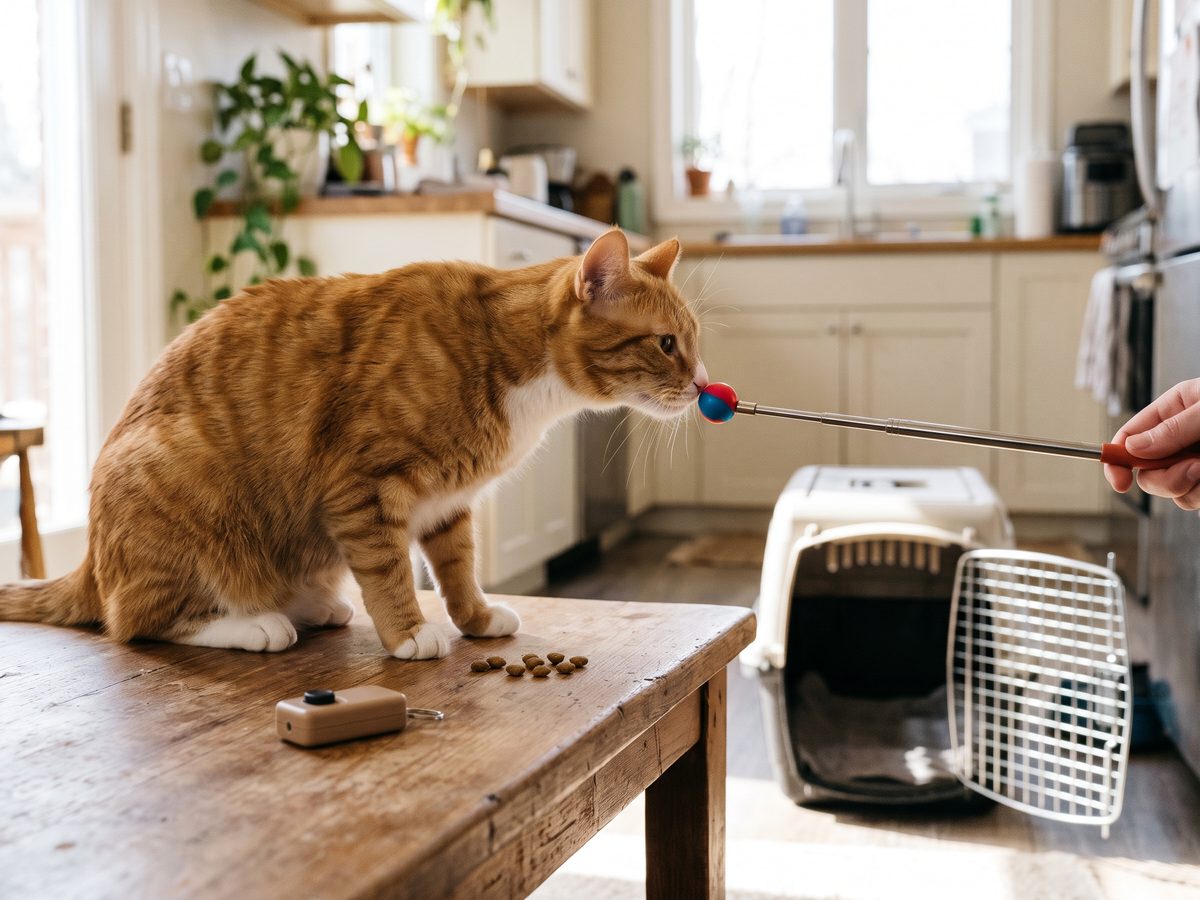
Each of the three skills below builds directly on the one before it.
| Skill | What it teaches | Where it leads |
|---|---|---|
| Charging the clicker | The click sound itself predicts a treat, before any behavior is asked for | Every later skill depends on this association being solid first |
| Target training | Following a target stick or fingertip to a specific spot on cue | Guiding a cat's movement precisely, without physically handling it |
| Carrier training | Walking into and settling inside a carrier voluntarily | Vet visits and travel without a chase-and-stuff struggle |
Charging the Clicker
Before a clicker means anything to a cat, the sound has to be linked to a reward again and again until the association forms on its own: click, then treat, with no behavior required yet, repeated a dozen or more times across a short session. Once a cat's ears perk up or it looks toward the treat hand the instant it hears the click, without waiting for the treat to already be moving, the clicker is charged and ready to mark actual behaviors going forward.
Rushing past this step and asking for behaviors before the sound reliably predicts a reward is what derails most clicker training attempts early on.
Target Training: Following a Stick or a Fingertip
Once the clicker is charged, target training teaches a cat to touch its nose to a stick or a fingertip on cue, clicking and treating the instant contact happens. Most cats pick this up within a handful of short sessions, since the natural curiosity that draws a cat toward a new object does most of the early work. A reliable target response becomes a useful tool beyond the training itself: guiding a cat onto a scale, off a countertop, or toward a specific spot in the house, all without physically picking the cat up or chasing it into position.
Carrier Training: The Skill That Pays Off Most
Of everything a clicker can teach, training a cat to walk into a carrier and settle there voluntarily solves one of the most dreaded routines in cat households: the pre-vet chase, struggle and stuffing that leaves both cat and owner stressed before the appointment has even started.
Using the target skill to lead a cat toward and then into an open carrier, clicking and treating at each step closer, turns the carrier from a source of dread into a spot that predicts good things. Our carrier and travel guide covers the carrier itself and broader travel prep; this page covers the specific behavior training that makes using one far less of a fight.
Gear for the Three Clicker Skills
A basic button clicker with a distinctive, consistent sound covers the charging stage, and a lightweight target stick with a soft tip makes touch-training safer and easier to see than a bare fingertip alone. Small, soft training treats that a cat can eat in one bite keep sessions moving quickly without pausing for chewing between clicks.
The carrier itself, the object all this training builds toward, is covered in depth on the carrier and travel page, since fit and style matter more there than they do for the training tools listed here.
Frequently Asked Questions
Whether a special clicker matters, and how many sessions it takes to see results, dominate the questions here.
Does clicker training require an actual clicker, or will any small noisemaker do?
A dedicated clicker works best because its sound stays distinctive and consistent every time, and cats lose interest in an inconsistent signal even more readily than most dogs do. A tongue click or a specific word can substitute in a pinch, as long as it stays exactly the same every time.
How many sessions does it take before a cat understands the clicker means a treat is coming?
Many cats connect the sound to a reward within a handful of short sessions across a day or two, though timing varies a fair amount from cat to cat. A cat that flinches at or ignores the sound after several attempts may need a quieter clicker or a longer charging period.
What's the difference between clicker training and just giving treats for good behavior?
The click marks the exact instant a cat does the right thing, even from several feet away, in a way that handing over a treat a second or two later can't match precisely. That precision is what makes shaping a specific, exact behavior possible, instead of just rewarding roughly the right idea.
Can an older cat still learn with a clicker, or does it only work on kittens?
Age isn't the limiting factor. A cat of any age can learn the clicker-treat association and build on it, though a senior cat may need shorter sessions if mobility or stamina has declined.
How long should a single clicker session last?
Two or three minutes at a stretch keeps most cats engaged far more reliably than a longer session, since interest tends to drop off quickly once a cat has had enough treats or simply loses focus. Several short sessions across a day beat one long one for keeping a cat engaged.
Does target training have any use beyond tricks?
Yes. A reliable target-stick response can guide a cat onto a scale for a weight check, into a carrier, or away from a doorway during a busy moment, which is a far more practical payoff than any party trick clicker training teaches.
Related Reading
- Carriers and travel: the carrier itself.
- Cat treats: rewards that work.
- Harness training: another skill to teach.
A cat that shows no interest in food during training sessions, or that seems unusually reluctant to move compared to its normal self, is worth a veterinary conversation before assuming it simply isn't a training candidate. Loss of appetite and reduced activity can both point to something medical.