Burmese and Tonkinese Cats: Dog-Like Devotion and the Weight Watch
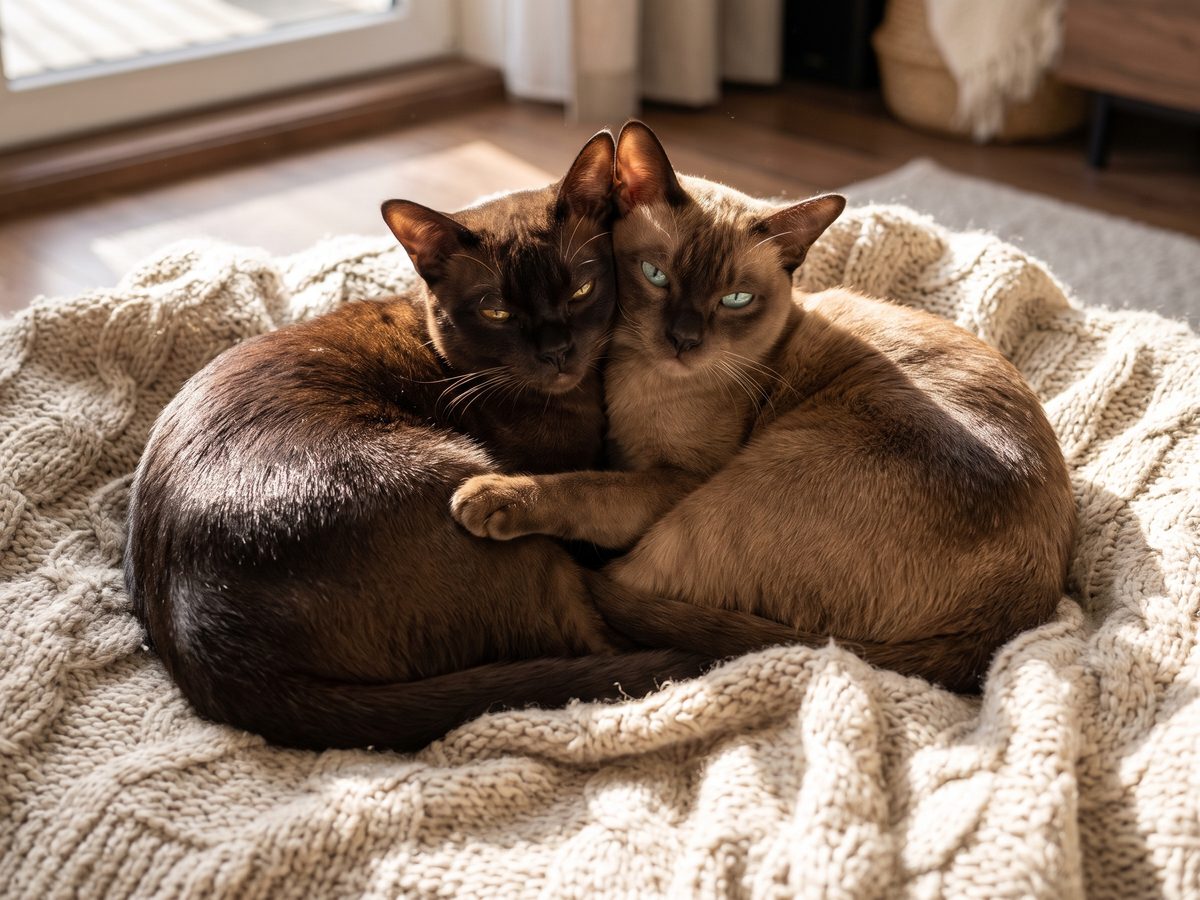
Two closely related breeds, one shared devotion. The table below lines up where they match and where they differ.
| Breed | Vocal level | Build | Weight risk | Lifespan | Good with |
|---|---|---|---|---|---|
| Burmese | Low, occasional soft voice | Compact, surprisingly heavy for its size | Elevated, hidden by muscular build | About 10–16 years | Households wanting a devoted, quiet companion |
| Tonkinese | Moderate, between Burmese and Siamese | Similar compact build, slightly leaner | Elevated, same hidden-weight pattern | About 12–16 years | Households wanting devotion with more chatter |
People-Oriented in a Way That Reads as Dog-Like
Both breeds tend to attach strongly to their household, following a favorite person from room to room, greeting arrivals at the door, and pushing to be part of whatever's happening instead of watching from a distance.
That devotion is the headline trait for anyone drawn to these breeds, and it has a real cost attached: a Burmese or Tonkinese left alone for long stretches regularly can struggle deeply with the isolation in a way a more independent breed usually doesn't. A household wanting a constant companion gets exactly that; one hoping for a low-involvement cat should look elsewhere.
A Softer Voice, Still Used Often
Neither breed matches a Siamese's loud, carrying call, but calling either one silent misreads the pattern. A soft chirp, murmur, or trill shows up regularly to announce a person's return, request attention, or narrate movement around the house. A Tonkinese tends to sit slightly higher on the volume scale than a Burmese, closer to the middle ground between the two ancestral lines it carries.
Our Siamese & Oriental care guide covers that louder, more insistent vocal style for direct comparison; a Burmese or Tonkinese sits at a gentler volume on the same general spectrum, closer relatives in ancestry than in decibel level.
The Weight Watch a Compact Build Demands
Both breeds carry a strong food motivation paired with a dense, muscular frame that hides early weight gain surprisingly well. A Burmese or Tonkinese can be meaningfully overweight before it becomes obvious by eye. Measured portions instead of free feeding, and a feeding amount set with your vet instead of guessed from a bag's chart, pull noticeably more weight for this pairing than the same habits would for a breed whose weight gain shows up visibly and early. Running a hand along the ribs periodically catches what a glance alone tends to miss on this particular build.
A Serious Warmth-Seeking Habit
Sunny windowsills, heating vents, and whoever happens to be sitting down all rank as prime real estate to both breeds, a warmth-seeking tendency stronger than casual cat behavior. This pairs naturally with the people-focused temperament described above, since settling on a warm person satisfies both instincts together, explaining why either breed picks the occupied chair over the empty one nearby. Providing a heated bed or a reliably sunny perch as an alternative gives a Burmese or Tonkinese somewhere to settle that doesn't always require a person to be sitting still first.
A Short List for a Velcro Cat with a Food Agenda
A portion-control measuring cup and a slow-feed bowl both pull real weight against this breed pair's easy weight gain, doing more for long-term health than any grooming purchase would.
A heated cat bed or a suction-cup window perch gives a dedicated warm spot that doesn't depend on a person sitting still, and a soft-sided carrier with mesh panels keeps a cat within sight and hearing of the household during travel, instead of shut away in a solid box. A wand toy pulls its own weight on the activity side of managing that easy weight gain, and a rotating set of small toys helps hold the interest of a cat that would rather be near a person than entertain itself.
Frequently Asked Questions
How attached these cats get, and how easily they gain weight, are the two questions this page answers most.
Are Burmese and Tonkinese cats as clingy as people say?
People-focused is the fairer description. Both tend to shadow a favorite person through the house, greet arrivals at the door, and dislike being shut out of a room. It reads as dog-like devotion more than typical cat independence, and a household wanting a more hands-off companion may find it a lot.
Are these breeds as loud as a Siamese?
Usually softer and less frequent. Both carry a gentler voice than a Siamese's carrying, insistent call, though neither stays silent. A quiet chirp or murmur to announce presence or request attention is typical, without the near-constant vocal habit a Siamese is known for.
Why do Burmese and Tonkinese cats gain weight so easily?
A strong food motivation combined with a compact, muscular build that hides extra pounds well makes weight creep easy to miss until it's already established. Measured portions and a vet-set feeding amount carry extra weight of their own here, well beyond what a breed with visibly early weight gain would need.
Why does my cat always want the warmest spot in the house?
A strong warmth-seeking habit runs through both breeds, showing up as claiming a sunny windowsill, a heating vent, or whoever is sitting down first. It's simply a temperament trait, worth planning household spots around instead of fighting.
What's the actual difference between a Burmese and a Tonkinese?
A Tonkinese comes from crossing Burmese and Siamese lines, landing temperamentally between the two: more vocal and active than a Burmese, calmer than a Siamese. A Burmese on its own tends to be the more solidly built and the quieter of the pair.
Do these cats do well left alone during a workday?
Less well than a more independent breed. Both tend toward strong attachment and can struggle with long stretches of solo time. A household away for extended hours regularly might consider a second cat for company, or plan for extra engagement once someone's home.
Are Burmese and Tonkinese good with children?
Often yes, since both breeds' people-seeking temperament tends to extend readily to kids who handle a cat gently. Supervision with very young children still matters for any cat, but the natural sociability here works in a family household's favor more than against it.
Related Reading
- Bombay: a Burmese-derived breed.
- Siamese and Oriental: the louder relatives.
- How much to feed a cat: portions for a food lover.
A weight change either direction, or a normally devoted cat suddenly avoiding company, deserves a vet check, not a guess about mood or metabolism. This page describes typical temperament and build, not your individual cat's health.